
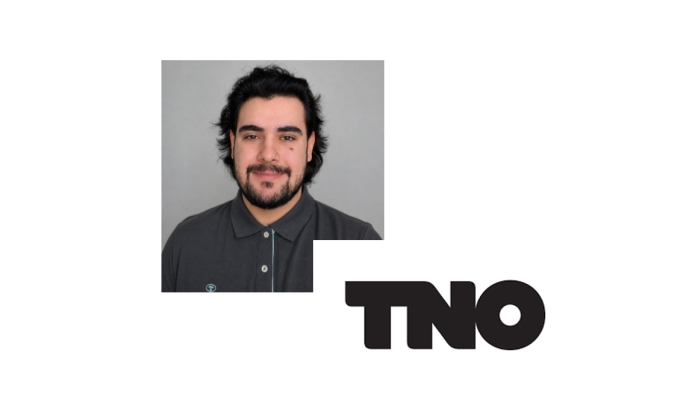
I am a Project Manager at TNO, the Netherlands Organisation for Applied Scientific Research, where I work on topics related to Collaborative Digital Twinning. I hold a degree (BSc/MSc) in Computer Science and Engineering from Eindhoven University of Technology (TU/e). Since joining TNO in 2024, I have managed European and national projects on digital twins and data sharing, in areas ranging from electric truck logistics and megawatt charging to wind energy.
What was your original motivation to become a researcher/project manager?
During my studies in computer science I enjoyed the technology, but I found that what I enjoyed even more was the work around it., namely bringing people with very different backgrounds together around a shared goal, and then making it happen. Applied research is a great place to do that. At TNO I work between researchers, industry and public partners, and a big part of my job is translating between what is technically possible and what is useful in practice.
What is your (main) research area today?
We focus on digital twins that are built and used by many organisations together, not by a single company. That raises practical questions, how do tools from different parties talk to each other, how is data shared securely, and how does every owner stay in control of their own data and models? Most of my projects apply this to the energy transition, from battery-electric trucks and charging infrastructure in logistics to data sharing in offshore wind.
What is the main focus of your team in BELOGIC?
TNO leads Work Package 4, which is all about integration. BELOGIC improves at least ten digital tools that help logistics companies plan and run battery-electric trucks on long-haul missions. To be useful, those tools have to work with the TMS and FMS that companies already rely on, and every company uses different ones. Together with our partners, we are standardising how tools and these systems communicate: a common data model building on open standards such as COVESA, and a single generic TMS/FMS API, for which TNO will publish a reference implementation. We are building this on DLite, TNO’s digital integration platform, which has already been developed and tested in the ZEFES and FLEXMCS projects. Alongside the integration work, TNO brings two tools of its own: digital vehicle agents that predict energy use and arrival times, and a depot charge planning tool.
From all your activities within the project, what are you the most proud of/keen to share with the public?
It is still early days for Work Package 4, so for now I am most proud of the groundwork. Before designing any interface, we collected requirements from the logistics companies, truck manufacturers and tool providers in the consortium. I am also proud that we are not starting from zero. DLite has grown from project to project, from ZEFES to FLEXMCS and now BELOGIC, so the lessons from one project directly benefit the next. And what I am most keen to share, the aim is an open standard, so that logistics companies and software providers outside the project can connect to it as well.
How do you expect the BELOGIC results will impact your organisation and the transport sector in Europe?
For TNO, BELOGIC is an important step for DLite: from a research platform towards something that supports daily logistics operations, and that we can make available more widely after the project. For the sector, the impact is about lowering the barrier to going electric. Today, every new digital tool often means a new custom integration, which is costly for companies that operate on thin margins. With a common standard, a logistics company can choose the tools that fit its missions and connect them to its existing systems without being locked in to one vendor.
